

What gsm actually measures
Gsm stands for grams per square metre, and it is the standard way paper and card weight is measured in the UK. It is a measure of density and stiffness rather than physical thickness on its own, though in practice a higher gsm card is almost always thicker and stiffer to hold. Standard printer paper sits around 80-100gsm, so even the lightest business card stock at 300gsm is roughly three times heavier than an office document.300gsm vs 350gsm vs 400gsm in practice
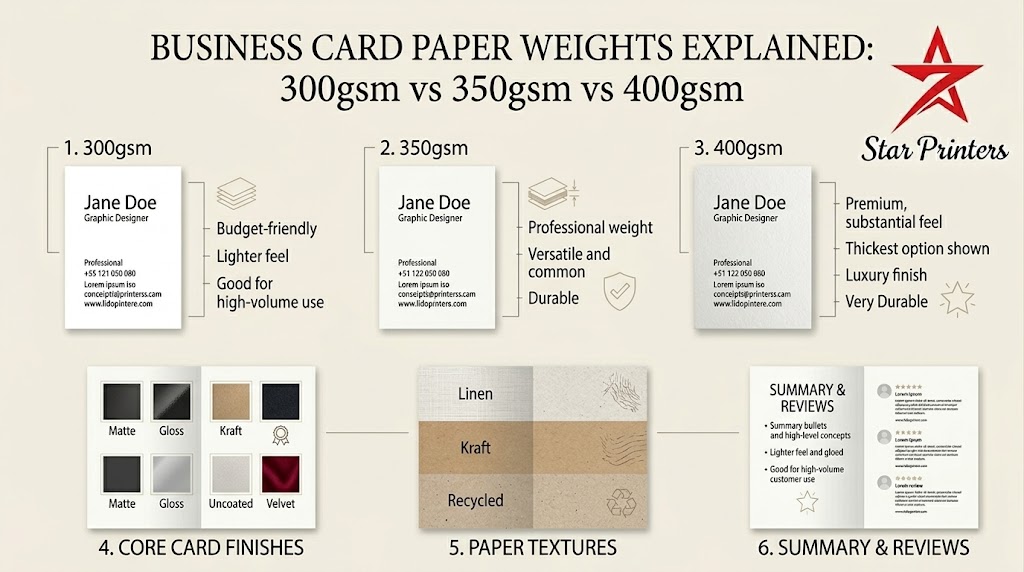
300gsm is the lightest weight commonly used for business cards, and it is a reasonable, cost-effective choice if budget is the main concern or you are ordering a large run. It still feels noticeably more substantial than a flyer or a standard printed sheet, but next to a 400gsm card in the same stack, it can feel slightly thin. 350gsm sits in the middle and is a popular choice precisely because it splits the difference: sturdy enough to feel premium without the cost jump of the heaviest stock. 400gsm is the heaviest commonly available weight, giving the stiffest, most substantial card, the kind that is hard to bend accidentally in a wallet or pocket. At Star Printers, business cards are available across this range so you can choose based on how the card will actually be carried and used, not just on price.When a lighter weight still makes sense
Weight is not automatically better. If you are testing a new design, a new business name, or ordering ahead of an event where cards might be handed out in bulk and not kept long-term, a lighter 300gsm run keeps costs down without wasting a heavier stock on cards that may only be used once. Save the heavier weights for a card you expect to be final, kept, and referred back to.How weight interacts with finish
The weight you choose also affects how a laminate finish reads. A matt or silk laminate on a 400gsm card gives the most premium, rigid feel of any combination, while the same finish on a 300gsm card can feel slightly less substantial even though the surface finish is identical. If a premium feel matters more than cost, pairing the heaviest stock with a laminate finish is generally the combination that gives the best result.Paper weight and paper thickness are related, not identical
GSM measures weight, not thickness. The higher the gsm, the heavier the card, and heavier card is usually thicker and stiffer, but two stocks with the same weight can differ in thickness depending on how they are made. That is why handling a sample is more reliable than comparing numbers alone.
Coated and uncoated paper
Coated stocks have a smooth surface that gives sharp colour and takes lamination well. Uncoated paper has a natural, slightly textured feel and is easy to write on, which suits cards that people will annotate. Both are available in different weights, so weight and surface are two separate choices.
Why this matters in the finished product
In the print industry, gsm is the standard way to describe paper, so every printer uses the same measure. The weight you choose changes how the finished product feels in the hand, how it stands up in a wallet and how it comes across when you hand it over.