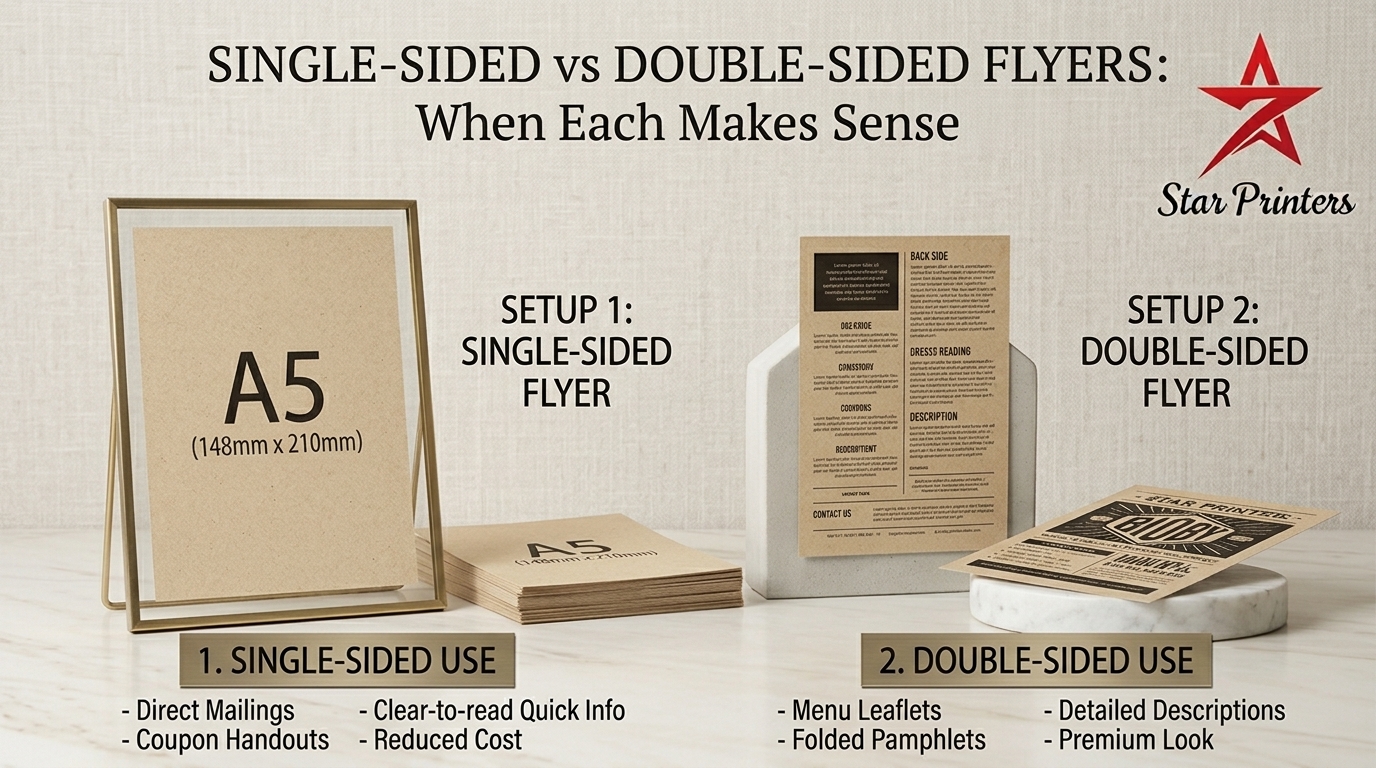
What actually changes between single and double-sided
The obvious difference is that double-sided printing uses both faces of the flyer instead of one, but the more useful way to think about it is in terms of content, not just cost. Single-sided flyers put everything on one face, which forces a simpler, more focused message. Double-sided flyers let you split content, a headline offer on the front, terms, a map or further detail on the back, without crowding a single page.
When single-sided works best
Single-sided suits a flyer with one clear message: an event date, a single offer, a simple announcement. It is also the more cost-effective option, since printing only one side is cheaper than printing both, which matters on very large runs. If your flyer is going to be glanced at quickly, on a counter, handed out on the street, a single, uncluttered side is often more effective than cramming content onto a second side that may never get turned over.
When double-sided earns its cost
Double-sided makes sense when you genuinely have two distinct pieces of content: a promotional side and an informational side, a menu with starters on one side and mains on the other, or a flyer that needs terms and conditions but shouldn't clutter the main design. It is also worth it if the flyer doubles as a reference item, something people are meant to keep and refer back to, rather than glance at once and discard.
Paper weight matters more for double-sided
One practical detail worth considering: printing on both sides makes any show-through from the paper more noticeable, especially on lighter stock. If you are choosing double-sided, a slightly heavier paper weight than you might use for a single-sided flyer keeps ink from one side showing faintly through to the other, particularly with darker or more solid-colour designs.
A common mistake to avoid
The most common misstep is printing double-sided purely out of habit, then leaving the second side sparsely filled or repeating information already on the front. If the back of your flyer does not add anything a reader needs, it is usually better value, and a cleaner result, to print single-sided and keep the design focused on one strong side.
Choosing for your flyer
Star Printers prints flyers both single and double-sided at every size we offer, so the decision comes down to your content rather than a print limitation. If you are not sure which fits your job, describe what you want the flyer to communicate and we will advise on whether a second side is worth the cost. Browse our
flyer printing page, the full range of
printing services, or
contact us with your design.